What is Woman?
This Mother’s Day, let’s explore the Divine Feminine, the depths of mother and maternal love. All things are love, expressed or unexpressed, suppressed or expressed. A mother’s love is not always soft.
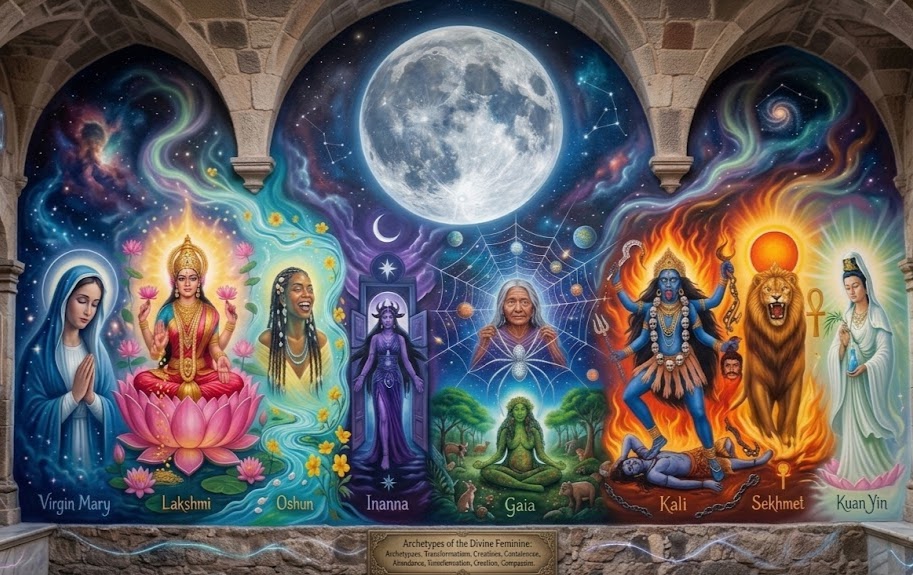
The archetype of the Divine Feminine is not a single static image, but an immense, shifting landscape mapped by nearly every culture throughout history. To explore these figures is to realize that the feminine equally involves the fierce roar of the lioness as it does the quiet flow of a wandering stream. We see this variety reflected in the contrast between figures such as Sancta Maria and Lakshmi, who represent two essential yet different ways of carrying sacred energy into the world.
In Christian tradition, Saint Mary represents the influence of the sacred vessel. Her importance lies in radical receptivity, the ability to say yes to a calling that surpasses human understanding. She represents the sanctity of the interior life as well as the strength needed to remain present with the sorrows of the world without turning away. Mary reminds us of the deep, subtle authority in being a container for grace and in the steady, nurturing acts of service that often go unseen. She is the unflinching acceptance of the unknown.
In contrast to this interior stillness, Hindu goddess Lakshmi represents the radiant flow of outward abundance. Depicted sitting on a blooming lotus, she embodies beauty, prosperity, and divine timing. Lakshmi teaches that genuine wealth is not simply financial, but an existence in accordance with the natural world. Her presence suggests that we can enjoy the luxuries and beauty of life without being consumed by them, much like the lotus, which remains pure white while anchored in the mud. She represents the fearlessness of owning our unique value. This allows giving and receiving, a cycle which keeps the universe flowing.
While Mary and Lakshmi provide a foundation of containment and flow, the figures of Oshun and Inanna invite us into the deeper waters of emotion and personal transformation. Oshun, the Yoruba deity of fresh waters and sensuality, teaches that sweetness is its own kind of power. She represents the irresistible pull of love and the necessity of joy in our spiritual practice. She reminds us that purpose is found in being present with the sparkle of the river and the warmth of human connection. Inanna, the ancient Sumerian Queen of Heaven, offers a more harrowing perspective through her mythic descent into the underworld. She represents the cycle of loss and rebirth, showing that true power often lies beyond our courage to pass through the dark night.
The landscape expands even further when we encounter the “Creatrix” figures, such as Grandmother Spider in the Hopi and Navajo traditions, who wove the universe into existence with silver threads of interconnectedness, and Gaia, the Greek personification of the sentient Earth itself. These figures remind us that we are not separate from nature but are born of it. When we need protection or the strength to clear away what no longer serves us, we look to fierce protectors. The Hindu goddess Kali acts as the devourer of time and ego, destroying illusions to reveal truth, while the lion-headed Egyptian Sekhmet reminds us that even our rage can be sacred; a tool for healing and justice.
Finally, we find balance in the quiet embodiment of compassion. Kuan Yin, a Buddhist bodhisattva, hears the cries of the world and refuses to turn away. Her tenderness is the epitome of mercy. These many faces serve as archetypal mirrors, reflecting the layered nature of our own lives. They give us permission to be whole. Whether we are in quiet reflection, fierce transformation, or vibrant expansion, we are participating in an enduring and holy story that transcends civilization and time. On this Mother’s Day, remember the sacred depths of the Divine Feminine and honor her many faces. Where does she live in you?